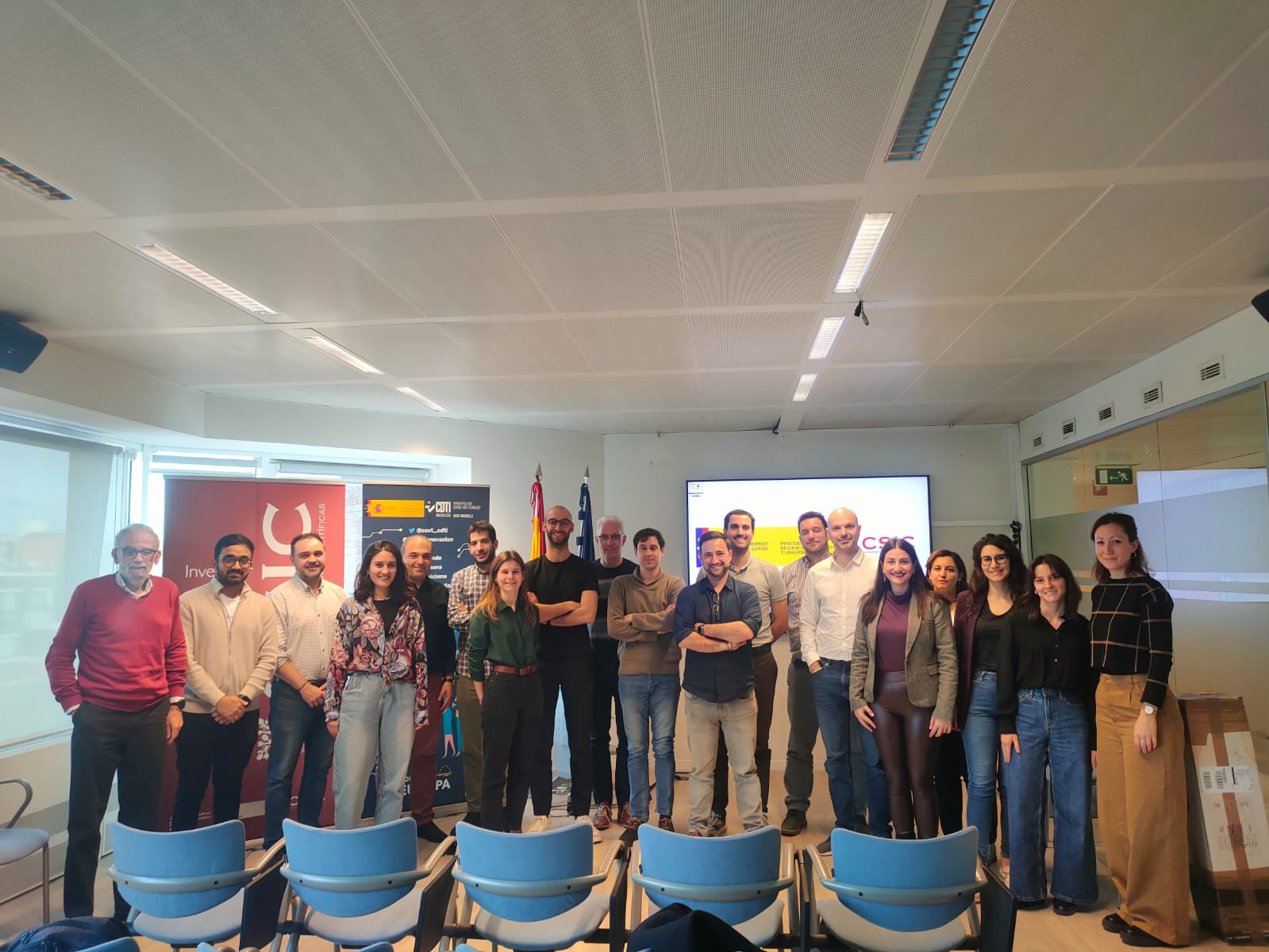
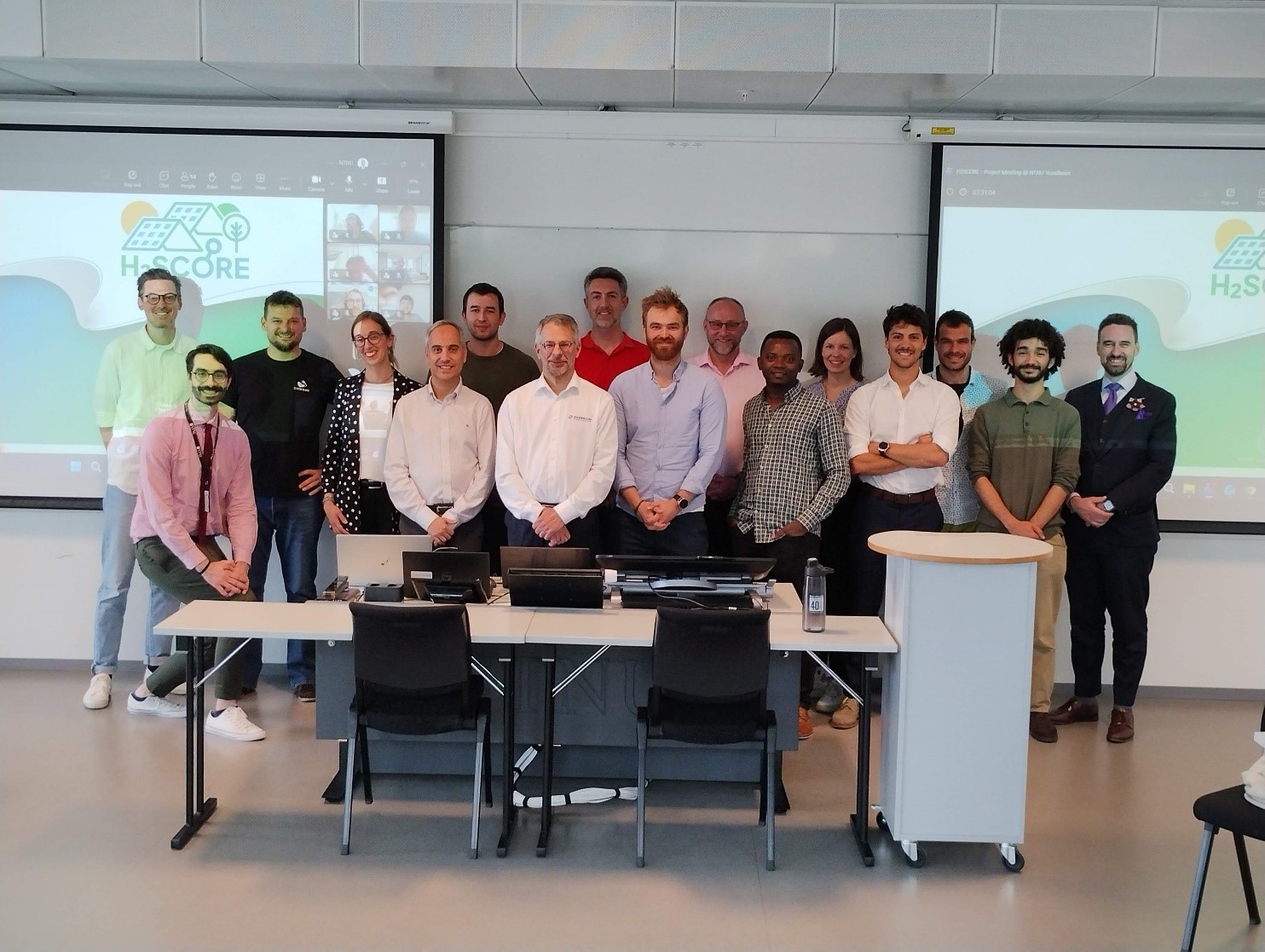
Trondheim, 3-4 June 2026 – After few months from the beginning of the project, H2SCORE’s partners join again to discuss activities planning and first steps at the meeting hosted by NTNU – Norwegian University of Science and Technology in Norway. At this stage the main focus is on H2SCORE conceptual design and site preparation, including permitting and safety aspects. In addition, technology specification for both low-temperature and high-temperature systems are other key steps as well as the technical coordination of all subsystems.
Since the beginning, Engreen, the company responsible for the H2SCORE conceptual design and demo site configuration, worked on the final layout to install and operate the different systems: the low-temperature system with PEM technology and metal hydride storage, the rSOC and the gasifier. The goal is to find a suitable area where the demonstration site could be kept and operated even beyond the end of the project. Therefore, having a clear technical description of all technologies is important to finalise the demo layout and to address similarly the permitting and safety analysis, the control architecture and the modelling activities similarly.
Focusing on the low-temperature system, its configuration includes containerised system integrating the PEM electrolyser, metal hydride storage, PEM fuel cell and related balance of plant components. BluEnergy Revolution explains that the system will be designed as an integrated power-to-hydrogen-to-power solution, with attention to safety, permitting, thermal integration and interaction with the local energy infrastructure (e.g. district heating, local energy grid and electrical cabinets). Meantime, it will be central to pay attention to the hydrogen quality requirements, especially in relation to the interaction between the electrolyser, storage and fuel cell; BluEnergy Revolution and Zeppelin Power Systems will also focus on the monitoring and control architecture of the low-temperature system, discussed as a cross-cutting topic depending on the overall engineering system.
When it comes to the reversible SOC system, expected to operate in both fuel cell and electrolysis mode, H2B2 is working on the design preparation, process and instrumentation diagrams and preliminary line lists, which will support the mechanical and electrical engineering work. Initially, the rSOC system will operate using hydrogen and, in the second phase, with syngas from biomass gasification. For this reason, the consortium will monitor the exhaust stream and will evaluate the use of afterburner or catalytic burner to avoid emissions of unreacted fuel and simplify the emissions measurement campaign.
Specific focus was also made on the gasifier and syngas cleaning concept: the system is based on biomass gasification using air, producing a hydrogen-containing syngas composed mainly of hydrogen, carbon monoxide, carbon dioxide, methane, light hydrocarbons and nitrogen. The consortium is evaluating specific technical requirements such as the gasifier size and the syngas flow rate in order to match the rSOC demand. Other important aspects are the biomass origin and quality, for which local woodchip and other biomass types (e.g. local waste biomass) are considered on the basis of some key parameters, especially the moisture content. Overall, the first steps were taken to set up the demonstration site, which will follow a specific plan to assess different operation phases in different seasons reaching up to 3000 testing hours. With respect to the above-mentioned activities environmental impacts measurement is also a complementary activity, performed by VTT through emissions analysis and LCA. It will start since the design phase, where PEMFC and rSOC exhaust streams will be monitored.
Parallel to the technological activities, the social acceptance and risk perception represent the main social topics to analyse. Taking advantages from previous experience with surveys and public acceptance studies on hydrogen technologies, partner NTNU will replicate them in H2SCORE’s project to explore differences in community perceptions among the real-life use cases in Italy, Spain, Switzerland and Canada. First survey and stakeholder engagement activity were performed during the launch public event last Febraury 2026 in Quarona: the outcome confirmed general interest and support from local stakeholders, while also highlighting the need for clear communication, transparent information and visible local benefits. Considering these survey’s results and the achievement of its own visual identity, H2SCORE is now ready to start the communication and the stakeholder engagement activities enabling the creation of a solid networking composed of organisations and communities with whom collaborate.
In June 4, the meeting in Trondheim was concluded with a join seminar organised by H2SCORE and the Norwegian research and innovation centre for hydrogen and ammonia HYDROGENi. The seminar presented and discussed research results and ongoing activities from the two complementary projects on hydrogen technologies, with a focus on safety, system integration, and energy applications. These two intense days have given further support to the launch of some important project activities, from the demo site and the definition of some technical details to the social aspects whose initial results we will see in the coming months.
H2SCORE is a Horizon Europe project (ID 101251551) supported by the Clean Hydrogen Partnership and its members and co-funded by the European Union. H2SCORE aims to test and demonstrate the effectiveness of integrating hydrogen technologies into local energy systems, such as Renewable Energy Communities (RECs), in order to increase flexibility, autonomy, and resilience. Within the project, Envipark is responsible for communication and dissemination activities, manages the testing activities of a portable hydrogen generator, and supports the analysis of the regulatory framework for hydrogen integration within CERs. For more info: www.h2score.eu